
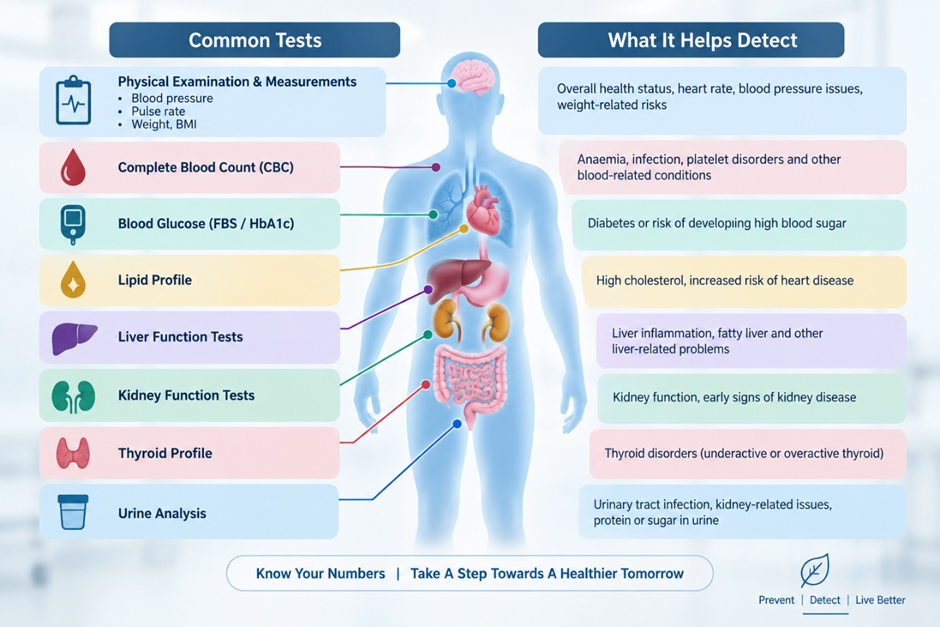
A routine medical assessment is designed to give a broad view of important health markers rather than test every possible condition. A full body checkup tests list commonly brings together basic measurements, blood investigations, urine testing, and selected checks based on age or individual risk.
The exact combination can vary between people because medical history, symptoms, medicines, family history, and previous reports all influence what is useful.
Commonly included checks
Understanding what is usually included can help patients know why each test is ordered and avoid assuming that a larger package is always more complete.
Understanding which tests may be included in a routine checkup is an important part of preventive care; learn more in Importance of Preventive Health Screening for Early Detection.
Basic measurements may include:
- Blood pressure
- Pulse rate
- Weight and BMI
Laboratory investigations may include:
- Complete blood count
- Blood glucose
- Lipid profile
- Liver function tests
- Kidney function tests
- Thyroid profile when appropriate
- Urine analysis
What does a full body checkup tests list usually assess?
A blood sugar screening can help identify abnormal glucose levels, while cholesterol screening provides information about lipid-related cardiovascular risk. A liver function panel measures selected enzymes and proteins linked with liver function, and a kidney function panel looks at markers such as creatinine and urea.
For more information on the availability and provision of laboratory diagnostic services, refer to the Guidance Document for Free Laboratory Services by the National Health Systems Resource Centre (NHSRC), India.
These results are not interpreted in isolation. Doctors consider symptoms, medical history, medicines, and previous values before deciding whether monitoring or further evaluation is required.
More tests do not automatically mean better preventive care. The useful set is the one that matches your individual risk profile.
Does everyone need the same set of tests?
No. The full body checkup tests list for one person may differ from another. Younger adults without known risk factors may need fewer investigations, while people with diabetes, high blood pressure, family history, or previous abnormal reports may require closer monitoring.
Additional investigations may be considered when:
- A previous result was abnormal
- Symptoms are persistent or unexplained
- There is a strong family history
- A chronic condition needs monitoring
- A doctor recommends age-specific screening
Checkup Guidance at Sri Ponni Medical Centre
The purpose of these investigations is to identify meaningful patterns rather than react to one isolated high or low value. Depending on the findings, a doctor may recommend lifestyle changes, repeat testing, further evaluation, or treatment.
Sri Ponni Medical Centre can help patients choose suitable investigations based on age, medical history, symptoms, and risk factors, followed by report review and appropriate follow-up.
For more information on health screening, preventive care, medical tests, and common health concerns, explore Important Health Topics Every Patient Should Know.